AI Agents
Autonomous AI agents that can reason, plan, and execute complex tasks using tools and external systems.
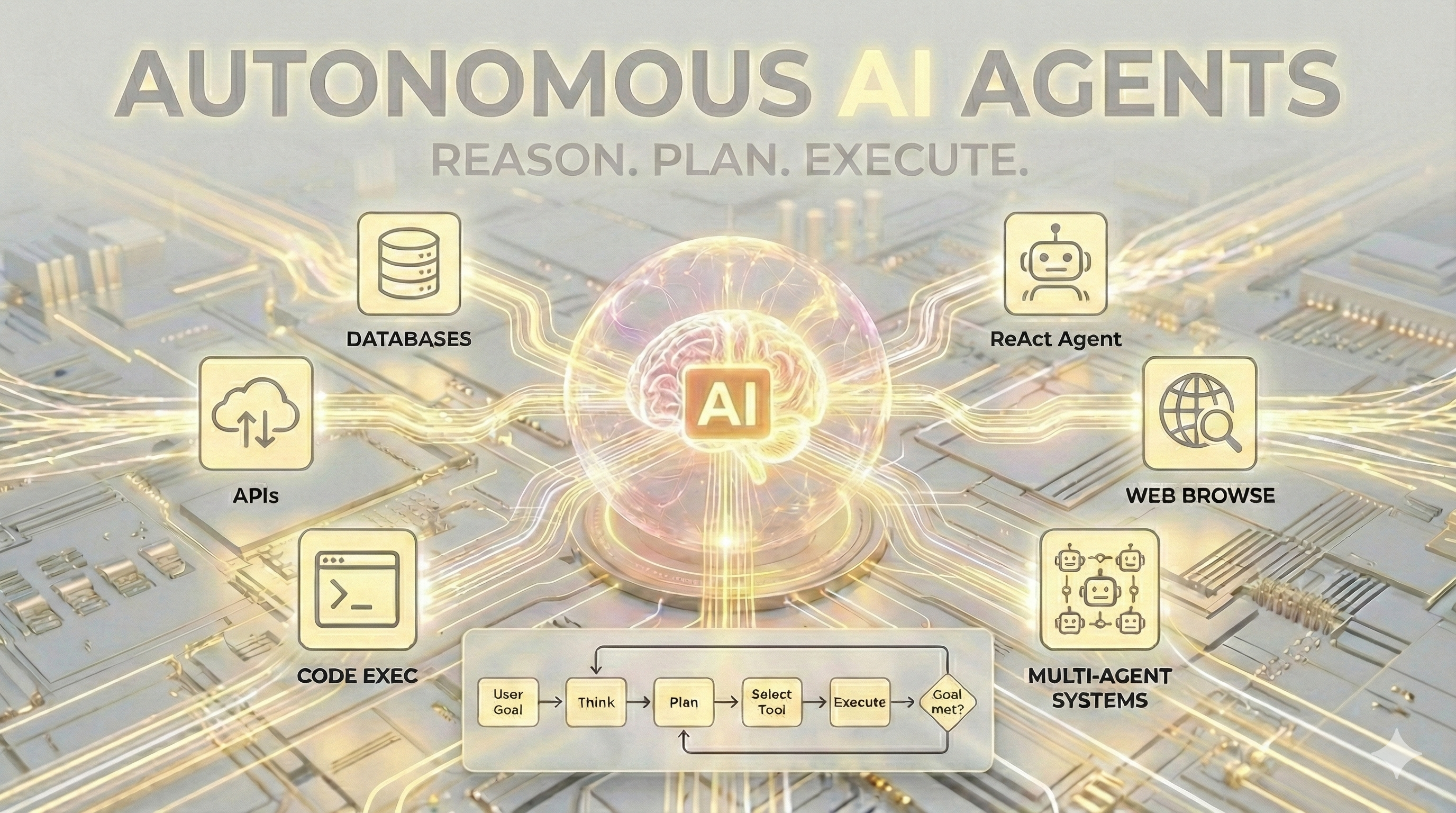
Autonomous AI Agents
AI agents go beyond simple question-answering. They can reason about problems, create execution plans, use tools, and complete multi-step workflows autonomously—transforming how businesses handle complex operations.
What Are AI Agents?
Beyond Chatbots
AI agents combine the reasoning capabilities of LLMs with the ability to take action:
- Reason: Break down complex problems into manageable steps
- Plan: Create and adapt execution strategies dynamically
- Act: Execute actions using tools, APIs, and external systems
- Learn: Improve based on feedback and outcomes
- Persist: Maintain context across extended interactions
How Agents Work
flowchart LR
    subgraph Input["User Goal"]
        A[Complex Task]
    end

    subgraph Agent["Agent Loop"]
        B[Think] --> C[Plan]
        C --> D[Select Tool]
        D --> E[Execute]
        E --> F{Goal Met?}
        F -->|No| B
    end

    subgraph Tools["Available Tools"]
        G[APIs]
        H[Databases]
        I[Code Exec]
        J[Web Browse]
    end

    A --> B
    D --> G & H & I & J
    F -->|Yes| K[Result]

    style Input fill:#e0f2fe,stroke:#0284c7
    style Agent fill:#fef3c7,stroke:#d97706
    style Tools fill:#dcfce7,stroke:#16a34a
Agent Architectures
We implement various agent patterns tailored to your use case:
ReAct Agents
Reasoning and acting in an interleaved manner:
- Thought-action-observation loops
- Dynamic tool selection based on context
- Error recovery and automatic retry logic
- Self-correction through reflection
Multi-Agent Systems
Teams of specialized agents working together:
- Role-based agent assignment (researcher, writer, critic)
- Inter-agent communication protocols
- Orchestration and coordination layers
- Consensus and conflict resolution
Autonomous Agents
Long-running agents with persistence:
- Goal-oriented behavior with planning
- Memory and context management
- Self-reflection and improvement
- Human-in-the-loop oversight options
Tool Integration
Powerful Through Tools
| Tool Category | Capabilities | Examples |
|---|---|---|
| APIs | REST, GraphQL, gRPC endpoints | CRM, ERP, third-party services |
| Databases | SQL queries, vector searches | PostgreSQL, MongoDB, Pinecone |
| File Systems | Document reading, code execution | Local files, S3, Google Drive |
| Web | Browsing, scraping, form filling | Research, data collection |
| Custom | Business-specific integrations | Internal tools, proprietary systems |
Frameworks & Technology
We work with leading agent frameworks:
| Framework | Best For | Key Features |
|---|---|---|
| LangChain / LangGraph | Complex workflows | State machines, conditional logic |
| AutoGen | Multi-agent conversations | Autonomous chat, code execution |
| CrewAI | Role-based teams | Agent personas, task delegation |
| Claude MCP | Tool integration | Standardized tool protocol |
| Custom | Specific requirements | Purpose-built architectures |
Use Cases
For Research Teams
- Research Assistants: Gathering, analyzing, and synthesizing information from multiple sources
- Literature Review: Automated paper collection and summarization
- Data Collection: Web scraping and API aggregation
For Development Teams
- Code Assistants: Writing, reviewing, and debugging code
- Documentation: Generating and maintaining technical docs
- Testing: Automated test generation and execution
For Business Operations
- Data Analysts: Querying databases and generating reports
- Process Automation: Complex multi-step business workflows
- Customer Service: Handling inquiries with full system access
Implementation Approach
- Discovery: Understand your workflows and identify automation opportunities
- Architecture: Design agent system with appropriate tools and guardrails
- Development: Build and test agent capabilities incrementally
- Integration: Connect to your existing systems and data sources
- Deployment: Roll out with monitoring and human oversight
- Optimization: Iterate based on real-world performance
Want to automate complex workflows with AI? Contact us to explore agent solutions.
Related Content
Building RAG Systems for Production: Lessons Learned
Retrieval-Augmented Generation (RAG) has become the standard approach for building AI systems that …
MLOps
MLOps Services Machine learning in production requires more than just model training. MLOps brings …
RAG Systems
Retrieval-Augmented Generation RAG systems combine the reasoning capabilities of Large Language …