mlops
machine-learning
devops
ai
kubernetes
model-deployment
monitoring
ci-cd
automation
MLOps
End-to-end machine learning operations for model training, deployment, monitoring, and continuous improvement.
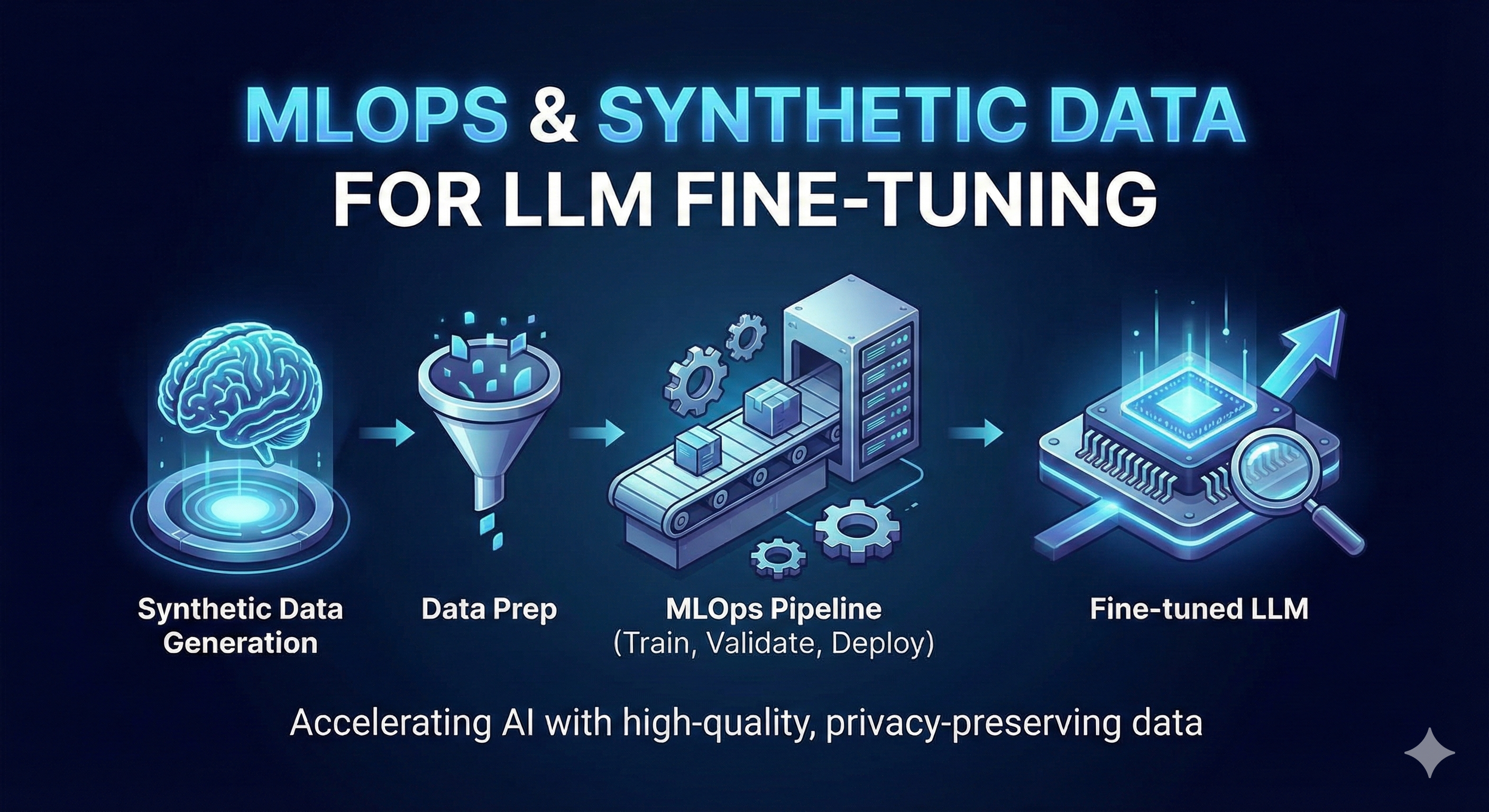
MLOps Services
Machine learning in production requires more than just model training. MLOps brings DevOps practices to ML systems, ensuring reliable, scalable, and maintainable AI deployments.
ML Systems Are Different
Unlike traditional software, ML systems can fail silently—degrading performance without throwing errors. MLOps provides the practices and tooling to detect, prevent, and recover from these failures.
MLOps Lifecycle
flowchart LR
    subgraph Dev["Development"]
        A[Data Prep] --> B[Training]
        B --> C[Evaluation]
        C --> D[Registry]
    end

    subgraph Deploy["Deployment"]
        D --> E[Staging]
        E --> F[A/B Test]
        F --> G[Production]
    end

    subgraph Ops["Operations"]
        G --> H[Monitor]
        H --> I{Drift?}
        I -->|Yes| A
        I -->|No| H
    end

    style Dev fill:#e0f2fe,stroke:#0284c7
    style Deploy fill:#fef3c7,stroke:#d97706
    style Ops fill:#dcfce7,stroke:#16a34a
Development Phase
| Stage | Activities | Tooling |
|---|---|---|
| Data Preparation | Collection, cleaning, validation | DVC, Great Expectations |
| Feature Engineering | Transformation, storage, serving | Feast, Tecton |
| Model Training | Experimentation, optimization | MLflow, W&B |
| Evaluation | Metrics, validation, comparison | Custom dashboards |
Experiment Tracking
- Version control for data, code, and models
- Hyperparameter logging and optimization
- Metric comparison across runs
- Reproducible training pipelines
Feature Engineering
- Feature store implementation
- Online and offline feature serving
- Feature versioning and lineage
- Real-time feature computation
Deployment Phase
Deployment Strategies
| Strategy | Risk Level | Rollback Time | Best For |
|---|---|---|---|
| Blue-Green | Low | Instant | Critical services |
| Canary | Low | Fast | Gradual rollout |
| A/B Testing | Medium | Moderate | Performance comparison |
| Shadow Mode | Very Low | N/A | Pre-production validation |
Model Packaging
- Containerization with Docker
- ONNX for framework-agnostic deployment
- Model optimization and quantization
- API standardization (REST/gRPC)
Infrastructure
Training Infrastructure
Cost Optimization
Our Kubernetes-based training clusters with spot instance support typically reduce training costs by 60-80% compared to on-demand pricing.
| Component | Purpose | Options |
|---|---|---|
| Compute | Model training | Kubernetes, Ray, Spark |
| Storage | Data and artifacts | S3, GCS, HDFS |
| GPUs | Accelerated training | NVIDIA A100, H100 |
| Scheduling | Resource management | K8s, Slurm |
Serving Infrastructure
| Server | Best For | Features |
|---|---|---|
| TensorFlow Serving | TF models | Batching, versioning |
| TorchServe | PyTorch models | Multi-model, metrics |
| Triton | Mixed frameworks | GPU optimization |
| BentoML | Rapid deployment | Easy packaging |
| KServe | Kubernetes native | Serverless, autoscaling |
Monitoring & Observability
Key Metrics
| Category | Metrics | Alert Triggers |
|---|---|---|
| Model Performance | Accuracy, F1, AUC | Drop below threshold |
| Latency | p50, p95, p99 | Exceeds SLA |
| Throughput | Requests/second | Capacity limits |
| Data Quality | Schema drift, nulls | Validation failures |
| Model Drift | Distribution shift | Statistical tests |
Drift Detection
- Data Drift: Input distribution changes
- Concept Drift: Target relationship changes
- Prediction Drift: Output distribution changes
- Feature Drift: Individual feature shifts
Automation & CI/CD
Pipeline Stages
- Code Commit: Trigger automated tests
- Data Validation: Schema and quality checks
- Model Training: Automated with tracked experiments
- Model Validation: Performance gate checks
- Staging Deployment: Integration testing
- Production Deployment: Gradual rollout
- Monitoring: Continuous observability
Orchestration Tools
| Tool | Best For | Key Features |
|---|---|---|
| Airflow | Complex DAGs | Battle-tested, extensible |
| Prefect | Modern workflows | Python-native, dynamic |
| Dagster | Data-aware | Asset-based, testing |
| Kubeflow | Kubernetes ML | End-to-end platform |
Tools & Platforms
| Category | Tools |
|---|---|
| Experiment Tracking | MLflow, Weights & Biases, Neptune |
| Feature Stores | Feast, Tecton, Hopsworks |
| Data Versioning | DVC, LakeFS, Delta Lake |
| Model Serving | Seldon, KServe, BentoML |
| Monitoring | Prometheus, Grafana, Evidently |
| Orchestration | Airflow, Prefect, Dagster |
Implementation Approach
- Assessment: Evaluate current ML maturity and pain points
- Architecture: Design MLOps platform for your scale
- Infrastructure: Set up training and serving environments
- Pipelines: Build automated training and deployment workflows
- Monitoring: Implement observability and alerting
- Documentation: Create runbooks and best practices
- Training: Enable your team with MLOps practices
Need reliable ML in production? Talk to us about MLOps implementation.
Related Content
AI Agents
Autonomous AI Agents AI agents go beyond simple question-answering. They can reason about problems, …
Backend & Cloud
Cloud-Native Backend Development We architect and build scalable backend systems using modern …
Computer Vision
Computer Vision Solutions We develop computer vision systems that extract actionable insights from …