webrtc
streaming
real-time
video-conferencing
live-streaming
peer-to-peer
media-server
low-latency
sfu
voip
xr
vr
ar
openxr
monado
WebRTC Solutions
Real-time communication platforms and streaming infrastructure for web, mobile, and XR applications.
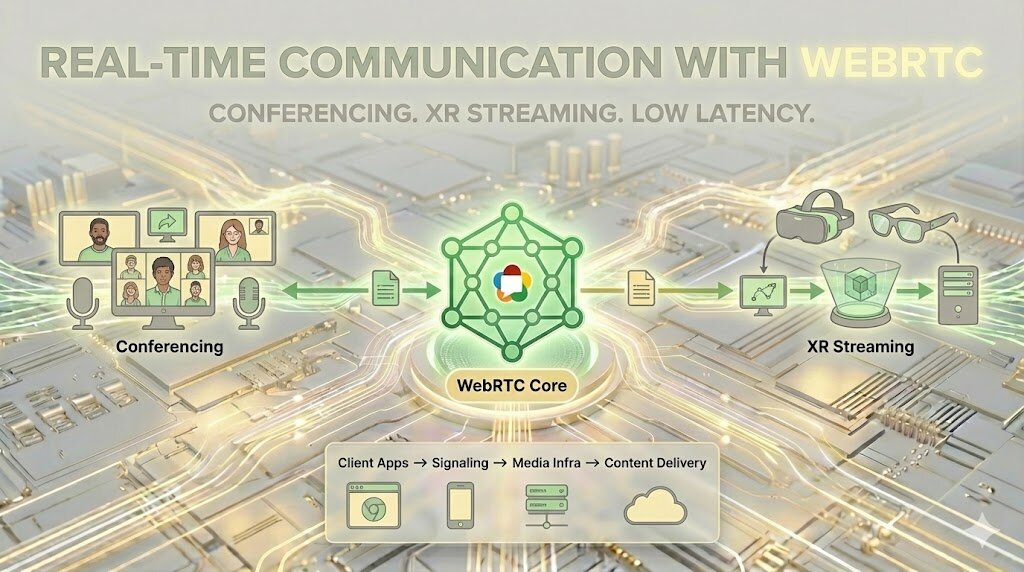
Real-Time Communication
We build WebRTC-based solutions for video conferencing, live streaming, and real-time data exchange. From simple peer-to-peer connections to large-scale streaming infrastructure.
Sub-Second Latency
WebRTC enables true real-time communication with latencies under 500ms—essential for interactive applications where every millisecond matters.
Architecture Overview
flowchart TB
    subgraph Clients["Client Applications"]
        A[Web Browser]
        B[Mobile App]
        C[Desktop App]
    end

    subgraph Signaling["Signaling Layer"]
        D[WebSocket Server]
        E[Session Management]
    end

    subgraph Media["Media Infrastructure"]
        F[TURN/STUN]
        G[SFU/MCU]
        H[Recording]
    end

    subgraph Delivery["Content Delivery"]
        I[CDN]
        J[Edge Nodes]
    end

    A & B & C <--> D
    D <--> E
    A & B & C <--> F
    F <--> G
    G --> H
    G --> I
    I --> J

    style Clients fill:#e0f2fe,stroke:#0284c7
    style Signaling fill:#fef3c7,stroke:#d97706
    style Media fill:#dcfce7,stroke:#16a34a
    style Delivery fill:#fce7f3,stroke:#db2777
Video Conferencing
Custom video conferencing solutions tailored to your needs:
| Feature | Capability | Implementation |
|---|---|---|
| Multi-Party Calls | Adaptive quality per participant | SFU architecture |
| Screen Sharing | Desktop, window, tab sharing | Screen capture API |
| Recording | Server-side, client-side | MediaRecorder, cloud storage |
| Integration | Calendar, CRM, workflows | REST APIs, webhooks |
Live Streaming
Scale Without Limits
Our streaming infrastructure scales from hundreds to millions of concurrent viewers with consistent sub-second latency.
| Capability | Description | Use Cases |
|---|---|---|
| Low-Latency Delivery | <500ms glass-to-glass | Interactive streaming |
| Multi-Platform | Web, mobile, TV | Broad reach |
| Interactive Features | Real-time engagement | Live commerce, events |
| VOD Integration | Live-to-VOD workflow | Content management |
IoT Video
Video solutions for embedded and IoT applications:
| Solution | Description | Benefits |
|---|---|---|
| Camera-to-Cloud | Direct streaming from devices | Remote monitoring |
| Remote Monitoring | Multi-device dashboards | Centralized control |
| Edge Processing | On-device video analysis | Reduced bandwidth |
| Low-Bandwidth | Adaptive bitrate, compression | Constrained networks |
XR Remote Rendering
VR/AR/MR Streaming
Stream high-fidelity XR experiences from powerful servers to lightweight standalone headsets—enabling superior graphics quality, reduced device costs, and extended battery life.
ElectricMaple & Monado Integration
We leverage the ElectricMaple stack for enterprise XR streaming solutions, combining OpenXR, GStreamer, and WebRTC for low-latency remote rendering.
flowchart LR
    subgraph Server["Rendering Server"]
        A[OpenXR Application]
        B[GPU Rendering]
        C[GStreamer Encoder]
    end

    subgraph Transport["WebRTC Transport"]
        D[Video Stream]
        E[Pose Data]
        F[Controller Input]
    end

    subgraph Client["XR Headset"]
        G[Monado Runtime]
        H[Display]
        I[Tracking]
    end

    A --> B --> C
    C --> D
    D --> G --> H
    I --> F --> E --> A

    style Server fill:#f3e8ff,stroke:#9333ea
    style Transport fill:#fef3c7,stroke:#d97706
    style Client fill:#e0f2fe,stroke:#0284c7
XR Streaming Capabilities
| Feature | Description | Benefit |
|---|---|---|
| Remote Rendering | GPU-intensive rendering on server | Lightweight headsets, longer battery |
| Low Latency | WebRTC + motion-to-photon optimization | Comfortable VR experience |
| OpenXR Standard | Cross-platform compatibility | Works with any OpenXR application |
| WiFi 6/6E Support | High-bandwidth wireless streaming | Untethered freedom |
Use Cases
| Application | Industry | Example |
|---|---|---|
| Training Simulations | Enterprise, Defense | Complex scenarios on thin clients |
| Design Review | Automotive, Architecture | High-polygon CAD models in VR |
| Remote Collaboration | Engineering, Healthcare | Shared XR workspaces |
| Industrial Visualization | Manufacturing | Digital twin inspection |
| Location-Based XR | Entertainment, Retail | Multi-user AR experiences |
Technology Stack
| Component | Technology | Purpose |
|---|---|---|
| XR Runtime | Monado | Open-source OpenXR implementation |
| Streaming | ElectricMaple | WebRTC-based XR transport |
| Encoding | GStreamer + NVENC/VAAPI | Hardware-accelerated video encoding |
| Tracking | Inside-out, external | Pose and controller tracking |
Hardware Requirements
Server: RTX 4090 or higher for 90Hz+ streaming. Client: Any OpenXR-compatible headset (Meta Quest, HTC Vive, etc.) with WiFi 6/6E for optimal latency.
Implementation Process
- Requirements Analysis: Define participants, quality, latency targets
- Architecture Design: Select topology (P2P, SFU, MCU)
- Infrastructure Setup: Deploy signaling and media servers
- Client Development: Build platform-specific applications
- Quality Optimization: Tune codecs, adaptive bitrate
- Scale Testing: Load testing and capacity planning
Building a real-time communication product? Reach out to discuss architecture and implementation.